
US Treasury Secretary Scott Bessent's remarks come ahead of a high-level summit where India and the European Union are expected to formally announce the conclusion of negotiations on a comprehensive free trade agreement.
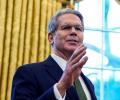
As in-person negotiations between India and the US kickstarted on Wednesday, Treasury Secretary Scott Bessent said he expected India to strike the first bilateral trade deal to avert President Donald Trump's reciprocal tariffs.

The US announced a 60-day pause on sanctions against Russia and tariffs on other countries, including India, to analyse the global economic impact. This decision, made via an executive order by Trump, has drawn significant criticism from both Republicans and Democrats, who had previously passed the Lindsey O. Graham Sanctioning Russia and Iran Act. US officials stated the waiver allows for assessment of global energy pressures and European allies' refusal to impose secondary sanctions on Russian oil buyers.

United States Treasury Secretary Scott Bessent has warned that Iranian airlines could be effectively shut out of international travel from Wednesday, September 23, as Washington threatens secondary sanctions against foreign companies that continue providing services to Iran's carriers.

On Thursday, September 24, Chinese President Xi Jinping and his wife Peng Liyuan were accorded a warm welcome by President Donald Trump and First Lady Melania Trump at the White House in Washington, DC.

In a major shift in Middle Eastern energy and security dynamics, the US Department of the Treasury on Monday issued a temporary 60-day general licence authorising transactions related to the production, delivery, and sale of Iranian crude oil, petrochemicals, and petroleum products.

The US Treasury Department is exploring the possibility of featuring Donald Trump's portrait on a new $250 note, pending congressional approval to amend the law that prohibits living individuals from being depicted on US currency.

The United States has sanctioned four India-based companies, including a customs broker and three other firms, for their involvement in importing petroleum and petrochemical products from Iran. This action is part of "Operation Economic Outcast," a broader US campaign to sever Iran's financial lifelines and prevent funding for its destabilising activities.

Chinese President Xi Jinping is set to visit the United States from September 23 to 25 for summit talks with US President Donald Trump, with discussions expected to cover critical economic and trade issues, including AI, and the recently signed US sanctions law targeting countries buying Russian oil and gas.
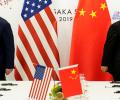
Top US and Chinese officials, including Vice Premier He Lifeng and Treasury Secretary Scott Bessent, held "candid, in-depth and constructive" talks in New York on economic and trade issues, with a specific focus on artificial intelligence. These discussions precede Chinese President Xi Jinping's anticipated visit to Washington and occur amidst new US sanctions targeting countries purchasing Russian oil and gas, and the US unveiling an "AI Force."

US Treasury Secretary Scott Bessent indicated a potential pathway to remove tariffs imposed on India for purchasing Russian oil, citing a significant decrease in such purchases. He also criticized Europe's approach and accused India of profiting from discounted Russian oil.

Indian benchmark indices Sensex and Nifty experienced declines in early trade, influenced by the escalating US-Iran standoff and persistently high crude oil prices, with experts predicting increased volatility.

US President Donald Trump's signature will soon appear on US paper currency, coinciding with the 250th anniversary celebrations of American Independence.

The United States launched military action against two Iranian launch systems on Larak Island, prompting Iran to claim retaliation with ballistic missile launches targeting two US air bases in Jordan.

Trump administration will use "alternative legal authorities" to enforce tariffs on the countries, assuring that the tariff revenue will remain unchanged.

Lieutenant General Apti Alaudinov, deputy chief of the Russian Armed Forces' Main Military-Political Department, has warned that the escalating conflict in West Asia could lead to Israel ceasing to exist as a state, accusing Israel of seeking to widen the confrontation to involve the US and NATO.

US President Donald Trump and Chinese President Xi Jinping began a crucial two-day summit in Beijing on Thursday, with both leaders signalling a desire to stabilise relations between the world's two biggest economies despite deep disagreements on trade, Taiwan, technology and security issues.

Chinese President Xi Jinping began his second state visit to the US, meeting President Donald Trump at the White House. Both leaders expressed a desire for a better future for their nations, with Xi emphasising cooperation over confrontation and the avoidance of the "Thucydides Trap." Discussions also touched upon artificial intelligence governance and the extension of a trade truce. The visit was notably marked by a media boycott of White House coverage due to a dispute over press access.

US intelligence agencies intercepted information indicating Iran had precise details of President Donald Trump's location in Ankara during a NATO summit, prompting a secretive departure due to a specific surface-to-air missile threat and the presence of a shoulder-fired missile near the summit.

The Kremlin has announced it will not disclose data on crude oil exports to India, citing concerns about 'ill-wishers'. This decision follows reports of increased Russian oil supplies to India and China amid geopolitical tensions.

India bought 1.87 million barrels of Russian oil per day in May so far, meeting approximately 40 per cent of its oil imports.

When asked about Bessent's announcement allowing certain Russian oil sales to India and whether the US is considering any other moves, including tapping the Strategic Petroleum Reserve (SPR), Trump said, "If there were some, I would do it just to take a little of the pressure off."

Bessent indicated that the U.S. is evaluating the status of Iranian oil as the current campaign progresses.

US Secretary of State Marco Rubio on Tuesday said the United States would prefer to end its extension of waivers on Russian oil "as soon as possible", while noting that such decisions ultimately rest with the US Treasury Department.

The Trump administration has announced a temporary authorisation for countries to purchase Russian oil stranded at sea, aiming to stabilise global energy markets amid rising oil prices and tensions with Iran.
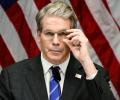
United States Treasury Secretary Scott Bessent has warned that the secondary tariffs on India could go up if 'things don't go well' during talks between President Donald Trump and Russian President Vladimir Putin in Alaska on Friday.
The United States has encouraged India to purchase Russian oil already at sea to mitigate supply shortages and price increases amid the West Asia conflict, according to Energy Secretary Chris Wright. This move is described as a short-term effort to stabilise the market without altering Washington's policy towards Russia.

The United States has extended a waiver from sanctions to allow countries to buy petroleum products from Russia by a month, days after it ruled out renewal of the special measure.

The United States has announced it will not renew sanctions exemptions for the purchase of Russian and Iranian oil, ending a 30-day waiver that allowed some countries, including India, to continue importing Russian oil despite sanctions related to the Ukraine war.

The Congress has strongly criticised the US government's temporary waiver allowing India to purchase Russian oil, raising concerns about continued 'American blackmail' and its impact on India's energy policy.

A source familiar with US Treasury Secretary Scott Bessent's thinking revealed on Saturday that the department "intends to utilise all available authorities to make Iranian assets accessible for rebuilding and repair efforts related to any future damage inflicted by Iran."

The United States has temporarily lifted sanctions on the sale of Iranian oil already in transit to ease soaring global crude prices, making 140 million barrels available to the market.
In the wake of the FTA between India and the European Union, the United States has described the Europeans as 'very disappointing', saying they were unwilling to join Washington, DC in putting tariffs on New Delhi for its purchases of Russian oil because of this trade deal.

Glimpses of US President Donald Trump's arrival in Tokyo, Japan, for the second stop on his Asia tour, October 27, 2025.

A peace deal between the US and Iran, set to be signed in Geneva, faces significant hurdles over the release of Iran's USD 12 billion in frozen assets, with conflicting reports from both sides on the conditions for their release.

The US has granted India permission to buy Russian oil already in transit to ease global supply pressures amidst the West Asia conflict. This decision comes after India agreed to halt sanctioned Russian oil purchases and substitute them with US oil.
US Energy Secretary Chris Wright said that long-term oil supplies are 'abundant' and there are no worries regarding that, but in the short term, there is a need to get oil on the market.
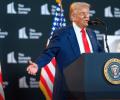
Sullivan remarks come amid the rising friction between Washington and New Delhi due to the 50 percent tariffs imposed on Indian goods, which include a 25 percent penalty for buying Russian oil.
Describing the India-United States relationship as 'very complicated', US Treasury Secretary Scott Bessent on Wednesday hoped that 'at the end of the day, we will come together.'
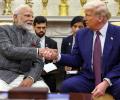
Amidst escalating tensions with Iran, the US has granted India a temporary 30-day waiver to continue purchasing Russian oil, aiming to stabilise global energy markets and encourage future US oil imports by India.
